Smarter Address Matching with USPS Standardization
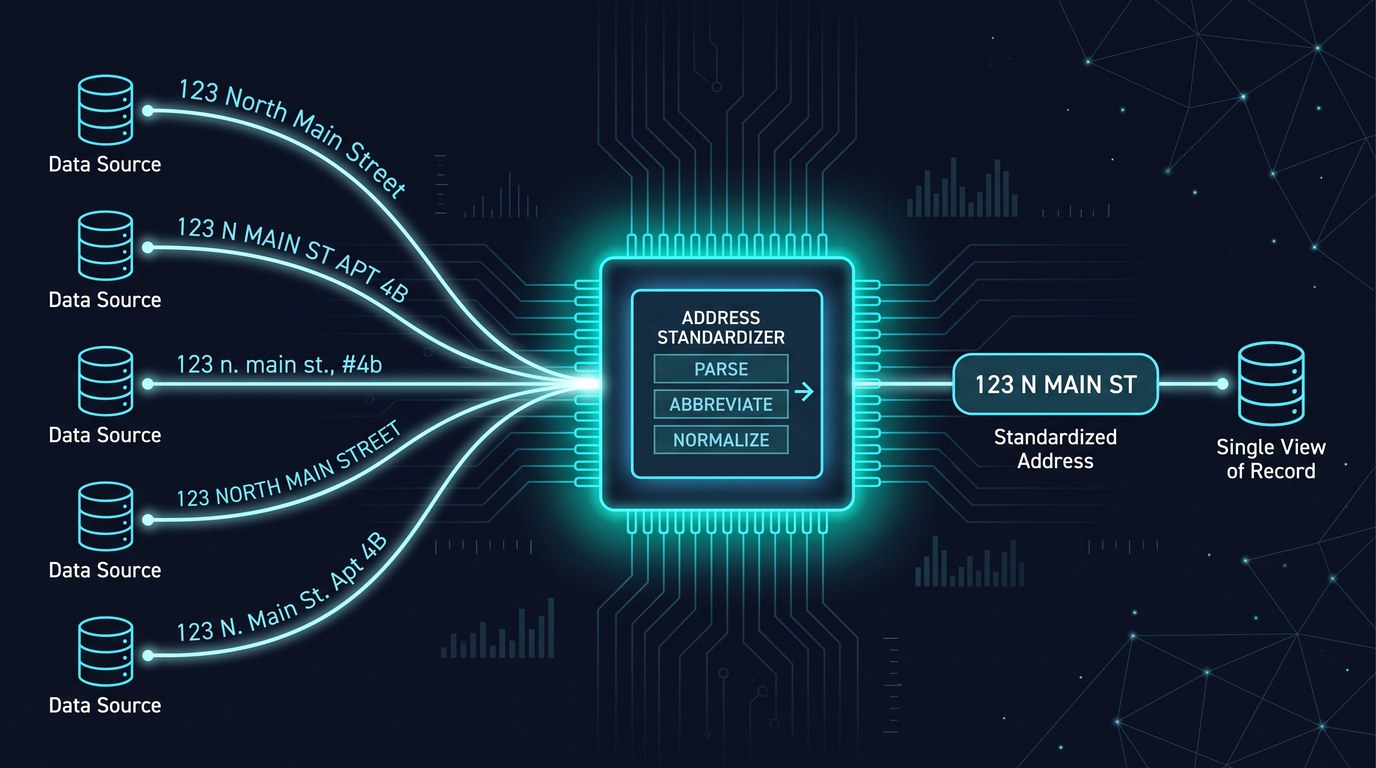
Street addresses are one of the strongest signals available for deciding whether two records describe the same person, provider, or organization. They are also, by a wide margin, the messiest field in most registries. The same delivery point can arrive as 123 North Main Street Apartment 4B from a registration desk, 123 N MAIN ST APT 4B from an automated feed, and 123 n. main st., #4b from a partner extract.
A person reading those three lines sees one address. A text comparison sees three unrelated strings. The result is a matching engine that either misses genuine duplicates or has to be tuned so loosely that it starts linking records it should not.
OpenEMPI now closes that gap with USPS Publication 28 address standardization, a new transformation that converts free-form street addresses into a single canonical form before matching ever happens.
One address, one representation
Publication 28 is the United States Postal Service’s authoritative standard for how an address should be written. OpenEMPI applies those conventions to every incoming address line: casing and punctuation are normalized, directionals and street suffixes are reduced to their official abbreviations, ordinal street names are made consistent, and secondary unit information is handled uniformly.
The three variations above all resolve to the same standardized value, which means:
- Records that differ only in address formatting are recognized as duplicates on the first pass.
- Address comparators produce stable, meaningful similarity scores instead of penalizing style differences.
- Matching thresholds can be tightened, improving precision without sacrificing recall.
The standardization is deterministic: the same input always produces the same output, so scores and results stay consistent across runs, environments, and cluster nodes.
Careful with the details that matter
Naive address cleanup does more harm than good. Blindly abbreviating every word that looks like a suffix turns NORTH STREET into N ST and destroys a real street name. ST JAMES AVENUE becomes nonsense if ST is read as Street rather than Saint. AVENUE B loses its identity entirely.
OpenEMPI’s standardization understands the structure of an address rather than treating it as a bag of words. It identifies which part of the line is the house number, the directional, the street name, the suffix, and the unit, and abbreviates only what genuinely plays an abbreviatable role. Distinguishing information is preserved, not flattened.
The same care extends to addresses that are not conventional street addresses. PO boxes, rural routes, highway contract routes, and county, state, and US highway addresses are all recognized and standardized to their canonical forms, so rural and box-holder records get the same match quality as everyone else.
Never worse than what you started with
Real registries contain addresses that no standard covers: international addresses, notes typed into the wrong field, entries such as HOMELESS, and outright garbage. When OpenEMPI cannot confidently interpret a line, it does not guess. It falls back to conservative cleanup — consistent casing, punctuation, and spacing with no rewriting — so the standardized value is always at least as useful as the raw one and never corrupted by an aggressive transformation.
Your original data is never modified either. The standardized address is written to a derived field alongside the source value, which remains untouched for display, export, and audit purposes.
Unit information on your terms
Apartment, suite, and unit numbers are useful for some purposes and noise for others. Two records for the same household may express the unit differently, or one may omit it entirely, which can suppress an otherwise obvious match.
OpenEMPI lets administrators decide how secondary unit information is handled. By default it is removed from the standardized address so that formatting differences in unit data cannot break a match. Alternatively, the unit can be moved into a field of its own, where it can participate in matching or manual review as a distinct attribute, or kept in place in standardized form for organizations that compare complete delivery lines.
Benefits across every entity type
Address quality is not a healthcare-specific problem. OpenEMPI manages records for many domain entities, and each of them benefits:
- Patients and members: Detecting duplicate registrations at the same residence across facilities and source systems.
- Providers and clinicians: Reconciling practice locations across credentialing systems and national registries.
- Organizations and facilities: Cleaning up site, branch, and department directories where each system formats addresses its own way.
- Business and customer registries: Unifying billing and service addresses collected through different channels.
Fits into the configuration you already have
Address standardization is applied the same way as OpenEMPI’s existing normalizations for names, phone numbers, and dates: configure it against the address field you care about, choose where the standardized value should land, and it applies automatically wherever records enter the system, whether through record creation, updates, or bulk import.
The resulting field can be referenced anywhere a field can be referenced. Matching configurations can compare it directly, blocking configurations can use it to group records that formatting differences would otherwise scatter across separate blocks, and search configurations can query against it. It also composes with other transformations, so phonetic or string-similarity treatments can be layered on top of the standardized value.
Addresses carry a great deal of identifying information. By making sure that identical addresses look identical to the matching engine, OpenEMPI turns one of the noisiest fields in your data into one of the most reliable.